
From Design to Mass Production: How Design for Manufacturability Reduces Medical Device Development Risk
Medical device development requires the integration of material evaluation, mold development, process planning, and quality validation from design to mass production. By implementing Design for Manufacturability (DFM) early in the development process, potential issues can be identified, development risks and modification costs reduced, and production efficiency and product consistency improved, laying a solid foundation for stable mass production.
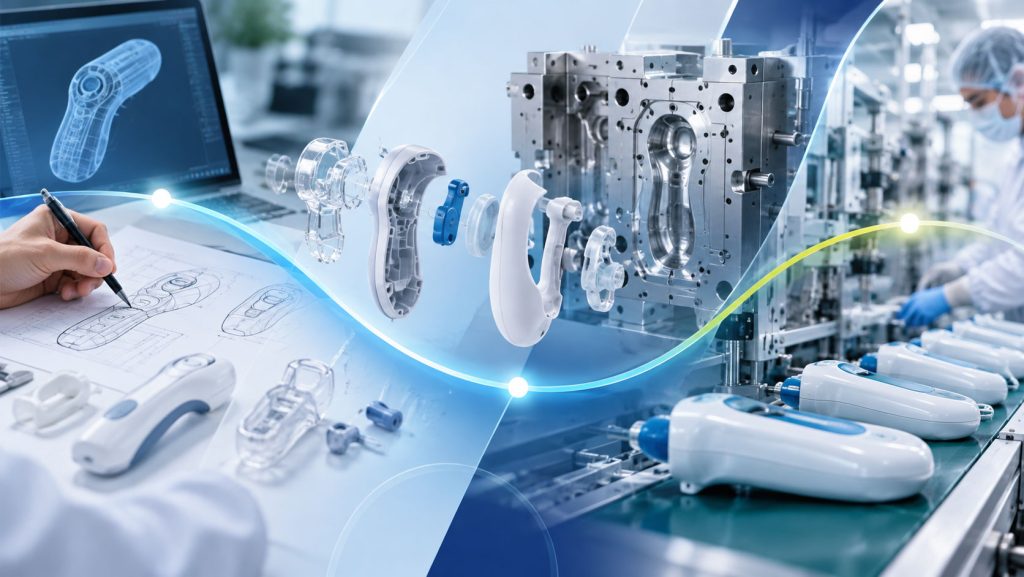
From Design to Mass Production:
How Design for Manufacturability Reduces Medical Device Development Risk
Connecting product concepts with materials, tooling, processes, and quality requirements early to build a foundation for reliable mass production.
Good Design Is Not Only About Feasibility
It Must Also Be Manufacturable Consistently
Integrating manufacturability early in product development aligns design, materials, tooling, processes, and quality requirements, reducing the risk of late-stage changes and pilot-production failures.
Medical device development is not only about completing the design; it also requires ensuring that the product can be manufactured, inspected, and produced consistently at scale. If dimensional tolerances, material processability, assembly methods, or mold structures are found to be problematic only after pilot production, development changes may increase costs and delay validation and market launch.
Design for Manufacturability (DFM) should be incorporated early in the development process. When design, engineering, manufacturing, and quality teams review the product together, potential risks can be identified sooner and the product design can be better aligned with actual manufacturing processes.
Integrate Manufacturability Early to Reduce Downstream Development Risk
As a medical product moves from concept to mass production, every design decision can affect downstream material selection, tooling structure, process conditions, quality inspection, and assembly methods.
The earlier design is aligned with actual manufacturing processes, the more effectively the costs of rework, retooling, and pilot-production failure can be reduced.
Three Critical Stages from Requirements to Pilot Production
Plan design and manufacturing processes in parallel so product development moves toward solutions that are executable, verifiable, and ready for mass production from the very beginning.
Requirements Definition
Confirm the required functions, use scenarios, target markets, and quality expectations, while also considering dimensional stability, chemical resistance, biocompatibility, mechanical strength, cleaning or sterilization conditions, inspection methods, and traceability requirements.
Design–Process Collaboration
From material evaluation and manufacturability analysis to tooling, fixtures, and assembly methods, every stage can affect product consistency. Plastic, silicone, and metal components also require different considerations for molding, machining, dimensional tolerances, and assembly fit.
Design Transfer and Pilot Validation
Translate design outputs into critical dimensions, material requirements, process conditions, inspection methods, and assembly standards. Pilot-production data can then be used to confirm that the process consistently produces products that meet specifications.
Completing the Design Does Not Mean Development Is Finished
After design transfer, materials, process conditions, inspection methods, and production workflows must still be confirmed for consistent execution. FDA guidance also identifies design transfer, verification, and validation as important control activities.
Improve Development Efficiency and Production Stability Through Early Integration
When design, materials, tooling, processes, and quality management are integrated early, companies can reduce the risks of rework, mold modification, and pilot-production failure while improving development efficiency and mass-production stability. For medical device OEM/ODM partnerships, connecting requirements analysis with design review, process development, validation, and production launch is key to creating long-term value.
Integrated Engineering and Manufacturing from Product Concept to Reliable Mass Production
HWAYING TECH integrates engineering development, material evaluation, plastic and LSR silicone injection molding, metal machining, automated assembly, quality inspection, and production launch support to help customers transform product concepts into manufacturing solutions that are executable, verifiable, and ready for mass production.
https://www.fda.gov/media/116762/download
https://www.fda.gov/regulatory-information/search-fda-guidance-documents/process-validation-general-principles-and-practices